
We delighted in sailing from NYC to Belgium! Though, technically it was two boats and two trains. We sailed across the Atlantic from NYC to Southampton U.K. on Cunard’s Queen Mary 2 (QM2), took a train to Dover, ferried across the Dover Strait to Calais France, and took a train to Kortrijk, Belgium. It was a grand adventure!
After flying into NYC, we took the train into the city where we enjoyed a picnic lunch from Leo’s Bagels in the beautiful Elevated Acre. From our vantage point, we were able to watch NYC commuting via helicopter (and probably tourists too) arriving and landing on the HeliNY helipad. After lunch, we walked down to Pier 11/Wall St terminal and ferried to the Red Hook/Atlantic Basin which drops off right at the Brooklyn Cruise Terminal. So much faster and easier (and less expensive) than other ways to get there, and it was fantastic to approach the Queen Mary 2 (QM2) by ferry!
Once aboard, we enjoyed walking through the ship, especially as we already knew our way around from the previous year. Our final goodbye to NYC was watching the passage of QM2 under the Verrazzano-Narrows Bridge from the highest deck. It looks so close with about 20-30 feet between the ship and the bridge deck (bridge clearance is about 230 feet and QM2 is about 200 feet above the water, depending on tides, the ships load, and the thermal expansion of the bridge). If you are wondering where QM2 is right now, check out Cruise Mapper: QM2.


The QM2 followed the east coast north a bit before sailing across the Atlantic Ocean! We thoroughly enjoyed our second crossing and decided to make this our bridge cruise (see that foreshadowing?). In this case, it was bridge the card game. We really enjoyed learning bridge and by strange coincidence, our teachers were from Colorado! During the cruise, we attended bridge classes in the morning and played in the tournament each afternoon. I love that it’s still a game where a computer has not beaten humans (computers have only beaten humans in a modified game without bidding and not playing with partners… but that’s not actual bridge). We studied and practiced and even won a few games and some points!
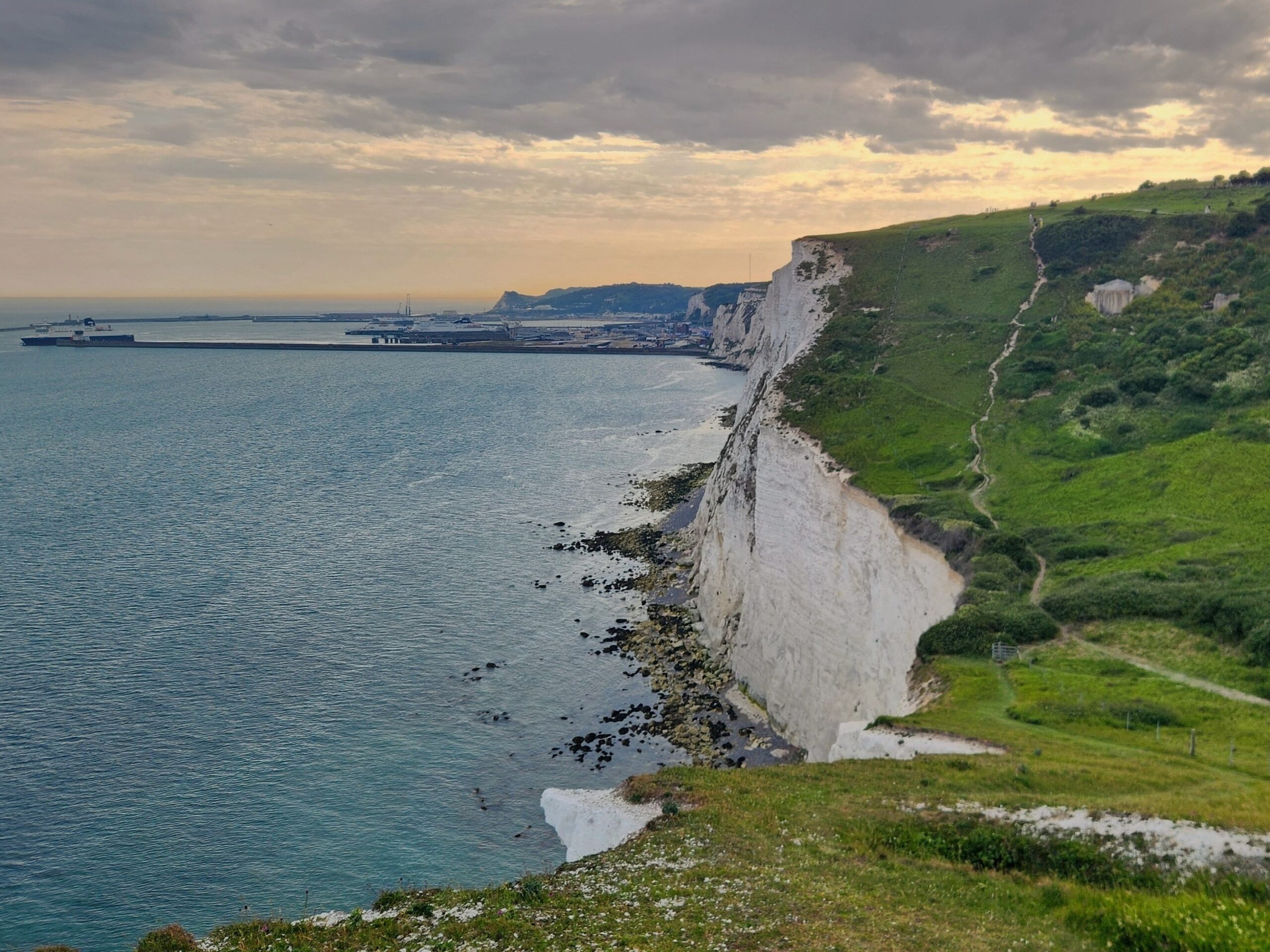
The QM2 docked in Britain in Southampton where we took the train to Dover. Dover was delightful and we enjoyed running and hiking through the cliffs, checking out the pier, and walking the promenade. We took a tour of the South Foreland Lighthouse perched atop the White Cliffs of Dover. It is now decommissioned and was part of a system of three lighthouses and lightships to aid in navigation and avoiding the Goodwin Sands, a sandbank in the Strait of Dover known as “Great Ship Swallower,” causing over 2,000 shipwrecks due to shallow, unpredictable waters. Today, there remains the North Foreland Lighthouse, East Goodwin Lightvessel (a lightship), and a number of buoys supporting navigation around the sands and through the Dover Strait.


One afternoon, we enjoyed walking (hiking) up to and touring Dover Castle. It is called the “Key to England” as it has been a strategic fortification throughout history. It may have been occupied even before the Roman conquest of Britain in 43 CE. The medieval castle was built by Henry II in the 12th century, rebuilt in the 19th century, with significant use in World War II including tunnels, an air-raid shelter, military command center, and underground hospital. We thoroughly enjoyed exploring the castle and the grounds. The view from the castle is gorgeous and the castle’s church belfry is a Roman lighthouse, the Dover Pharos, which is only one of three surviving in the world (the other two being the Tower of Hercules in La Coruña, Spain and Leptis Magna Lighthouse in Libya)!


We then took the ferry across the Strait of Dover to Calais, France and used the shuttle from the ferry port to get into town. While waiting for our train, we took a short walk from the train station and discovered the town hall, Hôtel de Ville. There was an amazing art exhibit of Alice in Wonderland in the garden we enjoyed too! Our train trip was very easy to our final destination in Belgium of Kortrijk (Dutch), Kortryk (West Flemish), Courtrai (French).
As with many Belgian cities, the center of Kortrijk is on the Leie (Dutch) or Lys (French) river. I like finding fun places to stay and chose Hotel Damier because it was close to the center of town (and well rated). What I didn’t know at the time is that it is the oldest hotel in Belgium, dating back to 1398! It was so lovely and we really enjoyed our stay in Flanders (northern Belgium). We walked through town and visited the Beguinage of Saint Elisabeth, an architectural complex for religious women who lived in the community without taking vows or retiring from the world. I always appreciate independent women! The twin Broel Towers (Broeltorens) are connected over the river by bridge, look identical, but were built at different times. The first was built to control traffic on the river Leie in 1385.
We enjoyed the many shops but especially the art gallery! And of course, we enjoyed visiting the churches of Kortrijk including Sint-Maartenskerk and Onze-Lieve-Vrouwekerk with the 1302 museum where we learned about the Battle of the Golden Spurs, an unexpected victory of the County of Flanders over France. We were delighted to find golden spurs hanging from the ceiling (very Harry Potter looking) and experience the reconstruction of the Kist van Kortrijk (Kist van Oxford or Courtrai Chest) with scenes from both the Battle of the Golden Spurs and Bruges Matins. The Flemish architecture is stunning, and even the Stadhuis (city hall) van Kortrijk is in a gorgeous building. .


We also enjoyed many restaurants with varying international fare, but a favorite was the Barouche, an easy Mediterranean restaurant. In addition, we delighted in finding local sweets including chocolate from Leonidas, we also bought Cuberdons from a street vendor. We got multiple flavors, but the original raspberry is outstanding! We also enjoyed the Belgian beer from dark to a sweeter favorite, Kriek (cherry beer), especially at the patio behind Mary’s Irish Pub.
Thanks for making it to the end!
Fun fact… in researching this post and Flanders (the region in North Belgium), I discovered that Dutch and Flemish are the same language. The share the same grammar and spelling, but differ in pronunciation, vocabulary, and tone. They are equivalent to English in the U.S.A. versus U.K. or Spanish in Spain versus Latin America. So cool (American English), ace (British English), gaaf (Dutch), geweldig (Flemish), guay (Spain Spanish), genial (Latin America Spanish), chilero (Guatemalan Spanish)! Enjoy!